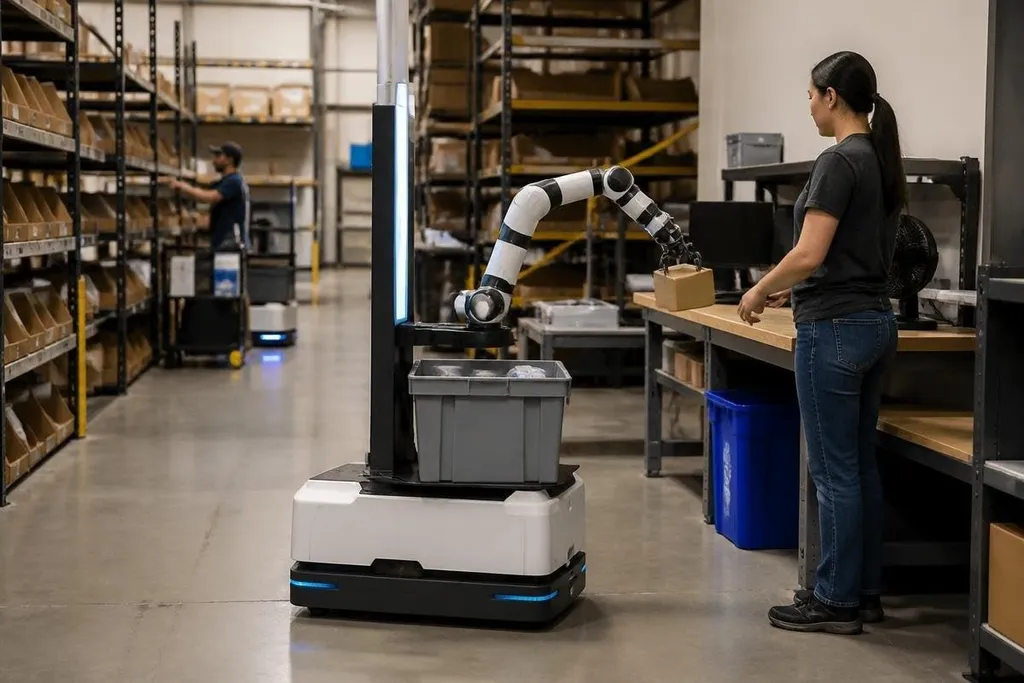
An e-commerce robot earns its place by moving an order from a storage location to a packing bench with few human stops. The next wave of systems will need to handle the full task around that move, including item choice, safe travel, handoff, charging, and recovery after a mistake.
This article uses no product or deployment data, so it does not rank named robots. It sets out the tests that matter when new systems reach a warehouse.
- Order work must continue after the demo ends
- Grippers need to handle mixed items, not one prepared object
- Human handoffs and recovery matter as much as travel speed
The task is bigger than transport
Many warehouse robots move shelves, bins, or packages along known routes. That work can save walking time, but it leaves several hard steps to people.
An order may contain soft packaging, a small item beside a large one, or an object that looks different from its stored image. A more useful system would connect three jobs: finding the right item, picking it without damage, and placing it in the next container.
Each job creates a separate test. A system that carries a tote well may still fail when its gripper meets a loose cable or a partly empty bag.
The software also has to react when the expected scene changes. A blocked aisle, a missing item, or a tote in the wrong place should lead to a clear pause and a fast handoff, not a long period of confused movement.
Hands matter more than speed
Picking is where many e-commerce tasks become difficult. Boxes have flat faces and fixed shapes. Clothing, packets, cables, and small retail goods do not stay in one useful position.
The arm needs force control, which lets it adjust pressure while holding an item. It also needs cameras or other sensors that can locate objects when lighting, packaging, and pile shape change. Those parts matter because a damaged product turns a successful pick into a return.
The useful question is not how fast an arm moves between two points. It is how many correct items reach the next station without a person fixing the result. That measure includes failed picks, dropped items, pauses, and time spent asking for help.
A picking rate means little if the robot leaves an item in the wrong tote or waits for a person to clear a jam. On Robot 24, e-commerce robot reports can put item accuracy, handoff steps, test conditions, and human work in the same frame.
People remain part of the system
E-commerce sites do not run as closed robot rooms. Workers load stock, clear jams, check damaged goods, and handle orders that fall outside the normal path. A robot must make those handoffs clear and safe.
A worker should be able to see why the robot stopped and what action will restart the task. The controls need to work with gloves, the stop button needs to be easy to reach, and the robot should move at a safe speed near people.
Remote help can cover some failures, but it creates a new cost. If one person must watch several robots and solve each problem by hand, the system may move work rather than reduce it. Vendors need to report how often help is needed and how long each case takes.
Charging, repair, and data
A system that works well for a short test still needs a plan for the rest of the shift. Buyers should ask how it charges, what happens when a battery is low, and whether a worker can replace a damaged part without sending the whole system away.
The same care applies to software. A warehouse needs records of failed picks, blocked routes, safety stops, and manual takeovers. Those records help the team find repeated faults, but they also raise questions about access, storage, and worker privacy.
No evidence pack was supplied for a named machine, so claims about speed, payback, or reliability would be guesswork. I'd skip any purchase pitch that gives a cycle time but leaves out failed tasks and human help.
A buyer's working checklist
Use these checks before a trial becomes a purchase:
- Name the order task: write down the item types, container sizes, and handoff point.
- Count failed work: record dropped items, wrong picks, pauses, and manual resets.
- Test mixed stock: include soft packs, loose items, reflective packaging, and partly empty bins when those goods exist on site.
- Measure human help: log who steps in, why they step in, and how long recovery takes.
- Check service work: ask about spare parts, battery replacement, software support, and training.
The useful e-commerce robot will be the one that completes ordinary orders after the prepared demo ends. Until suppliers publish failure rates, recovery times, and service costs beside speed figures, buyers should treat a smooth picking video as a starting test, not a buying decision.